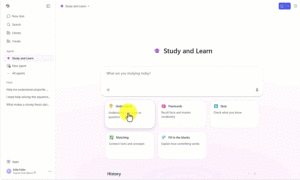




As the 2025-2026 academic season commences, Microsoft Education has unveiled an expanded suite of artificial intelligence tools and resources designed to address the escalating complexities of modern schooling. This initiative, centered on the integration of Microsoft 365 Copilot and the new Microsoft Learning Zone, represents a strategic pivot from viewing AI as a peripheral technological novelty to positioning it as a fundamental infrastructure for "human opportunity." By focusing on three primary pillars—administrative efficiency, personalized student support, and pedagogical innovation—the technology giant aims to mitigate the pervasive issue of educator burnout while simultaneously enhancing student engagement through adaptive learning environments.
The Evolution of AI in the Classroom: A Chronological Context
The current deployment of AI tools in education is the culmination of a multi-year development cycle that accelerated significantly following the public release of generative AI models in late 2022. Throughout 2023 and 2024, Microsoft conducted extensive pilot programs and gathered feedback from global educational institutions to refine the safety guardrails and functional utility of its Copilot interface.
By early 2025, the focus shifted from general-purpose chatbots to specialized "Learning Accelerators." The August 2025 rollout marks a critical milestone in this timeline, as it introduces the "Microsoft Learning Zone" into public preview. This development coincides with the broader availability of Copilot+ PCs and the integration of AI capabilities directly into the Windows ecosystem, signifying a transition toward hardware-software synergy specifically tailored for academic environments. This chronology reflects a broader industry trend where technology providers are moving beyond software-as-a-service (SaaS) toward holistic AI-native ecosystems.
Streamlining Administrative Workflows and Educator Productivity
A primary driver behind the adoption of Microsoft 365 Copilot is the need to reclaim instructional time for educators. According to various industry reports on teacher workloads, a significant portion of the workweek is consumed by non-instructional tasks, including lesson planning, rubric creation, and stakeholder communication. Microsoft’s latest framework utilizes Copilot Chat to automate these processes, allowing educators to generate draft communications, synthesize complex curriculum standards into actionable lesson plans, and personalize instructional materials for diverse student populations.
The utility of Copilot Chat extends to strategic institutional management. Education leaders are increasingly utilizing the tool to facilitate high-level communications, such as drafting newsletters for parents or outlining institutional policies regarding technology use. By providing a secure, AI-powered environment, the platform ensures that sensitive school data remains protected while offering the efficiency of large language models. The objective is not to replace the educator’s voice but to provide a foundational draft that reduces the "blank page" syndrome, thereby allowing staff to focus on high-impact interactions with students.
Personalized Learning via AI-Powered Learning Accelerators
At the heart of Microsoft’s pedagogical strategy is the suite of "Learning Accelerators." These tools—including Reading Progress, Reading Coach, Math Progress, and Speaker Coach—are designed to provide individualized feedback that would be logistically impossible for a single teacher to provide to a class of thirty or more students simultaneously.
Reading Coach, for example, utilizes AI to generate personalized stories based on a student’s specific reading level and areas of struggle. If a student consistently mispronounces words with certain phonetic patterns, the AI adapts the subsequent practice material to reinforce those specific skills. This real-time coaching mechanism is integrated into Microsoft Teams for Education, providing teachers with data visualizations that track progress at both the individual and classroom levels.

The impact of these tools is supported by emerging data on literacy and numeracy. By providing a "low-stakes" environment for practice, students often feel more comfortable making mistakes and receiving immediate corrections from an AI coach than they might in a front-of-class setting. This psychological safety is a critical component of the "Learning Accelerator" philosophy, aiming to bridge the achievement gap through consistent, data-driven intervention.
Empowering the Next Generation: AI Literacy for Students 13+
A significant policy shift in the 2025 rollout is the intentional empowerment of students aged 13 and older to interact with Copilot Chat. Recognizing that AI literacy will be a foundational requirement for the future workforce, Microsoft has established a framework where students can use AI as a "thought partner."
This integration is governed by strict ethical guardrails and institutional controls. The goal is to move students beyond using AI for simple answers toward using it for critical thinking and creative exploration. For instance, students might use Copilot to brainstorm research topics, summarize complex scientific papers, or debug code in a computer science course.
Microsoft’s "AI in Education" report highlights that digital literacy now encompasses the ability to prompt AI effectively, verify AI-generated information, and understand the ethical implications of automated systems. By embedding these tools into the daily academic workflow, schools are tasked with preparing students to navigate a digital landscape where AI is ubiquitous.
The Microsoft Learning Zone: A New Frontier in Adaptive Education
The most significant technological addition this season is the Microsoft Learning Zone, currently in public preview. This AI-powered learning application is specifically engineered for the Windows ecosystem, including Surface devices and Copilot+ PCs. It represents a shift toward "adaptive learning," where the software evolves in response to the user’s performance and feedback.
The Learning Zone serves as a centralized hub for educators to create customizable learning goals. It integrates learning science with AI innovation to provide a more immersive experience than traditional learning management systems (LMS). Key features include:
- Lesson Creation Tools: Utilizing generative AI to build multi-modal lessons that include text, imagery, and interactive elements.
- Data-Driven Insights: Providing administrators with a high-level overview of engagement metrics to identify at-risk students earlier in the semester.
- Hardware Optimization: Leveraging the Neural Processing Units (NPUs) in new Copilot+ PCs to handle AI tasks locally, improving speed and privacy.
Initial availability is limited to English-language users with specific Microsoft Education licenses (A1, A3, and A5), but expansion into additional languages and regions is expected following the preview phase.
Global Implementation and Institutional Case Studies
The efficacy of these AI tools is being validated by a growing number of institutions worldwide. Schools are utilizing Microsoft AI to reimagine teaching and operations in various ways:

- Individualized Instruction: In several districts, teachers have reported using AI to translate complex scientific concepts into multiple languages and reading levels, ensuring that English Language Learners (ELL) and students with IEPs have equitable access to the core curriculum.
- Operational Efficiency: Higher education institutions are deploying Copilot to manage the massive influx of administrative inquiries during the enrollment season, freeing up human advisors to handle more complex student support cases.
- Teacher Collaboration: Professional learning communities (PLCs) are using AI to analyze student performance data across entire grade levels, identifying trends that inform broader instructional shifts.
These real-world applications demonstrate that the most successful AI implementations are those that view the technology as an augmentative tool rather than a replacement for human expertise.
Official Responses and Industry Analysis
The reaction from the educational community has been a mixture of cautious optimism and a demand for robust training. Microsoft has responded by launching a comprehensive suite of free resources, including the "Microsoft 365 Copilot Toolkit for Education" and the "AI for Educators" course on the Microsoft Learn platform. These resources are intended to build "AI confidence" among staff who may feel overwhelmed by the rapid pace of change.
Industry analysts suggest that Microsoft’s strategy is a direct response to the "time poverty" experienced by modern educators. By automating the "drudgery" of teaching, the company is betting that educators will reinvest that time into mentorship and social-emotional learning—areas where AI cannot compete. However, experts also note that the success of this rollout depends heavily on the "Digital Divide." As AI becomes more integrated into the Windows hardware ecosystem, ensuring that underfunded districts have access to the necessary devices remains a critical challenge for the sector.
Broader Impact and Future Implications
The integration of AI into the 2025 academic year marks the beginning of a long-term transformation in pedagogy. As AI tools become more sophisticated, the role of the teacher is expected to shift from a primary "source of knowledge" to a "facilitator of learning." In this new model, the AI handles the repetitive drills and data analysis, while the human educator focuses on fostering critical thinking, ethical reasoning, and interpersonal skills.
Furthermore, the emphasis on AI-native hardware suggests that the future of education will be increasingly personalized. The "one-size-fits-all" model of the 20th century is being replaced by a dynamic, data-informed approach where every student has access to a 24/7 tutor and every teacher has an AI administrative assistant.
As Microsoft Education continues to iterate on these tools, the focus remains on the "human opportunity." The 2025-2026 school year is not merely another calendar milestone; it is the starting point for a new era of inclusive, student-centered learning that leverages the power of artificial intelligence to empower every student on the planet to achieve more. Together, educators and technology providers are navigating this fresh chapter, ensuring that the transition to AI-enhanced education is both meaningful and impactful for the next generation of learners.