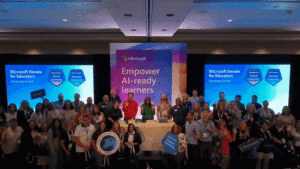



In a significant expansion of its educational technology ecosystem, Microsoft has unveiled a comprehensive suite of artificial intelligence tools designed to assist both educators and students. The announcement includes the introduction of specialized AI "agents" tailored for the classroom, new integrations within major Learning Management Systems (LMS), and a dedicated academic pricing tier for Microsoft 365 Copilot. These developments come at a pivotal moment as the global education sector grapples with the rapid integration of generative AI into curricula and administrative workflows.
The centerpiece of the announcement is the introduction of "Teach," an AI-powered assistant for educators, and "Study and Learn," an adaptive agent for students. These tools are designed to move beyond simple content generation, focusing instead on streamlining preparation for teachers and fostering critical thinking for learners. By offering many of these features at no additional cost to existing education customers, Microsoft is positioning itself to lead the digital transformation of the classroom while addressing the growing demand for secure, enterprise-grade AI solutions in academic environments.
A Strategic Response to the 2025 AI in Education Report
The timing of these releases is informed by the recently published 2025 AI in Education Report, which indicates a massive shift in how academic institutions interact with technology. According to the report, over 80% of respondents have already integrated AI into their school-related tasks. However, the data also highlights a gap between general-purpose AI usage and tools specifically designed for pedagogical needs.
Microsoft’s latest offerings are a direct response to this disparity. The company noted that while AI is being used widely, there are significant opportunities to refine these technologies to better serve specific educational goals, such as curriculum alignment and personalized student feedback. The goal is to provide a structured environment where AI acts as a co-pilot rather than a replacement for human instruction, ensuring that technology remains an "accelerator" for learning science.
Empowering Educators through the Teach Assistant
For educators, the most immediate update is the rollout of "Teach," a feature within the Microsoft 365 Copilot app. Designed to alleviate the administrative burden that often leads to teacher burnout, Teach allows educators to consolidate their planning tasks into a single, intuitive interface.
The functionality of Teach extends to several core areas of instructional design:
- Lesson Planning: Educators can generate comprehensive lesson plans that are automatically aligned with relevant academic standards.
- Material Drafting: The tool can draft quizzes, rubrics, and reading materials from scratch or based on existing documents.
- Customization and Adaptation: Perhaps most importantly, Teach allows for rapid modifications. An educator can take a single piece of content and instantly adjust its reading level, language, length, or difficulty to meet the diverse needs of a single classroom.
Teach is currently being rolled out to education customers at no additional cost. Microsoft has also confirmed that future updates will include deeper integrations with OneNote and Microsoft Teams, as well as direct connections to Learning Management Systems, allowing teachers to push AI-generated materials directly into their digital classrooms.
Fostering Student Growth with the Study and Learn Agent
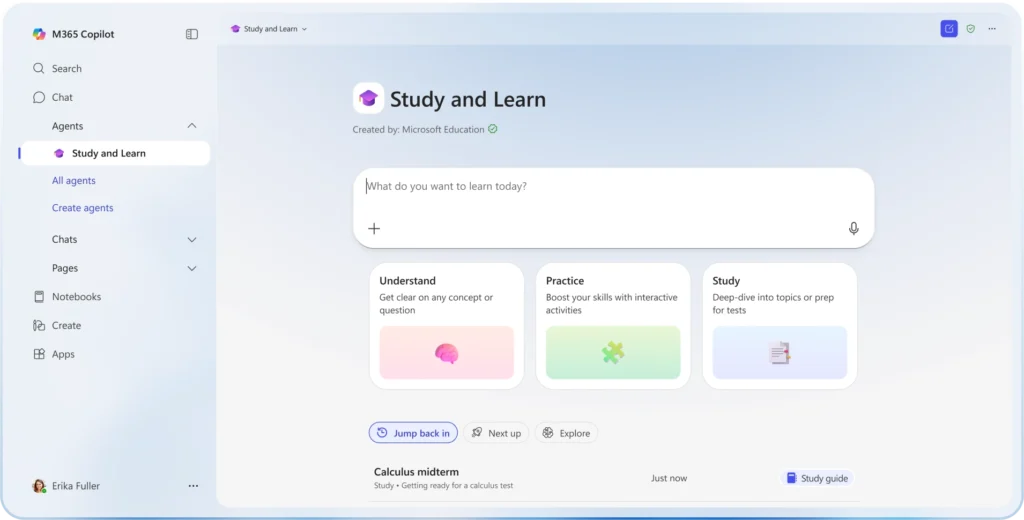
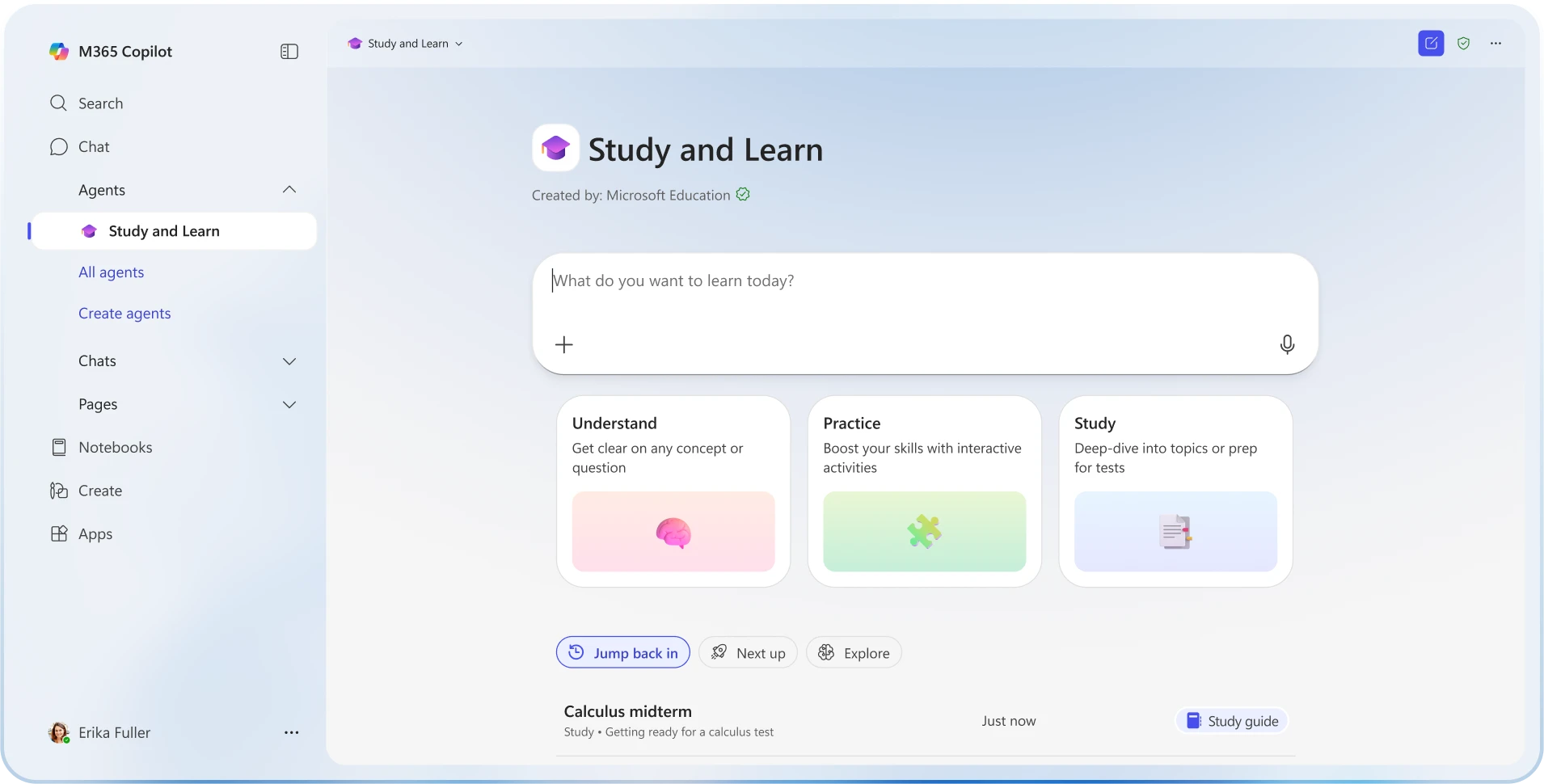
While educators receive tools for efficiency, students are being provided with "Study and Learn," an advanced AI agent grounded in learning science. Unlike standard chatbots that might provide direct answers to questions, Study and Learn is designed to act as a tutor that encourages reflective thinking and skill acquisition.

Scheduled for a preview release in November 2025, Study and Learn offers several interactive modes:
- Understanding and Practice: Students can engage in a dialogue to test their comprehension of a topic.
- Adaptive Exercises: The agent provides built-in activities such as flashcards, matching games, fill-in-the-blank exercises, and practice quizzes.
- Nurturing Voice: The system is programmed to help students find their own voice and build confidence, focusing on the process of learning rather than just the output.
By providing these tools at no additional cost, Microsoft aims to broaden access to high-quality tutoring resources, potentially narrowing the achievement gap for students who may not have access to private educational support outside of school hours.
New Academic Pricing and Enterprise Protection for Microsoft 365 Copilot
In addition to the free tools, Microsoft announced a specialized academic offering for Microsoft 365 Copilot. Starting in December 2025, the service will be available for $18 per user per month for educators, staff, and students aged 13 and older. This price point represents a significant adjustment designed to make the technology more accessible to institutional budgets.
The academic version of Copilot is not merely a rebranded consumer product; it is deeply integrated with institutional data. It allows users to query documents, emails, presentations, and meetings while maintaining "Enterprise Data Protection." This ensures that institutional knowledge remains secure and that the AI does not use sensitive school data to train its public models—a primary concern for IT administrators and privacy advocates.
Furthermore, the academic offering includes access to cutting-edge features such as:
- Researcher and Analyst: Tools designed to help higher education students and faculty synthesize vast amounts of academic literature and data.
- Copilot Tuning: Capabilities that allow institutions to customize the AI’s responses to align with specific campus policies or academic tones.
- Copilot Control System: A centralized management suite for IT departments to oversee AI deployment and ensure compliance with safety standards.
Integration with Learning Management Systems (LMS)
Recognizing that the modern classroom relies on various platforms, Microsoft is expanding its footprint within the LMS ecosystem. Starting in December 2025, Copilot Chat will be accessible within Canvas, Schoology, Brightspace, Blackboard, and Moodle through the Microsoft 365 Learning Tools Interoperability (LTI).
This integration is critical for adoption. By bringing AI directly into the platforms where students and teachers already spend their time, Microsoft reduces the friction of switching between apps. This "in-flow" experience allows for secure AI chat powered by GPT-5, providing students with immediate assistance on assignments within their primary learning environment.
Case Studies and Institutional Reactions
Early adopters of Microsoft’s AI tools have already reported measurable improvements in efficiency and engagement.
At Brisbane Catholic Education, CIO Leigh Williams reported that educators saved an average of over nine hours per week on administrative and planning tasks. "This empowers them to focus on the reason they came into education—supporting student learning and personalizing education in ways that weren’t possible before," Williams stated.
The University of South Carolina saw similar success, with 84% of users reporting time savings of one to five hours per week. Professors at the university noted an improvement in the quality of academic output, which allowed them to dedicate more time to high-value research and student mentoring.
In the K-12 space, Broward County Public Schools has begun utilizing "agents" to create interactive quiz engines and career readiness tools, such as resume and job description analyzers. These custom-built solutions demonstrate the flexibility of the Microsoft AI platform, allowing individual school districts to address their unique local challenges.
Timeline of Implementation and Future Outlook
The rollout of these features follows a structured chronology aimed at ensuring stability and security:
- October 2024: "Teach" begins rolling out in the Microsoft 365 Copilot app for education customers.
- November 2025: "Study and Learn" enters the preview phase for students.
- December 2025: The $18/month academic offering for Microsoft 365 Copilot becomes available.
- December 2025: LMS integrations for Canvas, Blackboard, and others enter preview.
This phased approach allows Microsoft to gather feedback and refine the AI’s pedagogical accuracy.
Broader Implications and Fact-Based Analysis
The introduction of these tools signifies a shift from "Generative AI" to "Agentic AI" in education. While early AI tools were primarily used for drafting text, these new agents are designed to perform complex workflows, such as aligning a quiz with state standards or acting as a long-term tutor.
From a competitive standpoint, Microsoft’s aggressive pricing and deep integration into the Office suite (Word, PowerPoint, Excel) pose a challenge to other tech giants like Google and specialized EdTech startups. By offering "Teach" and "Study and Learn" at no additional cost, Microsoft is leveraging its existing market share to set a new standard for what a "basic" educational software package includes.
However, the move also raises important questions about the digital divide. While the $18 price point is lower than commercial rates, it still requires a financial commitment that some underfunded districts may find difficult to meet. Microsoft’s counter to this is the suite of free tools, including "Learning Accelerators" like Reading Coach and "Minecraft AI Foundations," which aim to provide foundational AI literacy without requiring a premium subscription.
As AI becomes more embedded in the academic experience, the focus of the conversation is likely to shift from "if" AI should be used to "how" it can be used ethically and effectively. Microsoft’s emphasis on enterprise data protection and IT controls suggests that the company is prioritizing the security concerns of institutional leaders, a move that may be the deciding factor for widespread adoption in the coming years.
The transformation of education through AI is no longer a future prospect but a present reality. With these updates, Microsoft is attempting to provide the infrastructure for a new era of teaching and learning, where the "balancing act" faced by educators and students is supported by a sophisticated, secure, and pedagogically sound digital partner.