

The global education sector has officially transitioned from a period of cautious experimentation with generative artificial intelligence into a sophisticated new phase characterized by the demand for tools purpose-built for the classroom. According to the 2026 Microsoft AI in Education Special Report, the integration of AI in academic environments has reached a saturation point, with 92% of students and education leaders and 88% of educators reporting regular use of AI for school-related tasks. However, as the novelty of automated text generation fades, the academic community is pivoting toward a more critical objective: ensuring that AI supports deep learning and critical thinking rather than merely accelerating task completion.
The report, which surveyed over 3,300 respondents across diverse markets including the United States, the United Kingdom, Australia, Brazil, Japan, and Saudi Arabia, underscores a growing consensus that speed and efficiency are no longer the primary metrics of success. Instead, the focus has shifted toward pedagogical integrity. To address this, Microsoft has announced a suite of new AI-powered capabilities integrated into Microsoft 365 Education, designed to provide secure, student-centered experiences grounded in established learning science.
The Evolution of AI in the Classroom: A Chronology of Integration
The journey of AI in education has moved through three distinct stages over the last few years. In the initial phase, beginning roughly in late 2022 with the public release of large language models, schools reacted with a mixture of curiosity and alarm. Many districts initially moved to ban the technology over concerns regarding plagiarism and the erosion of foundational writing skills.
By 2024, the second phase emerged, defined by "productivity experimentation." Educators began using AI to draft lesson plans and emails, while students utilized it to summarize long readings. While these use cases saved time, they often bypassed the cognitive struggle necessary for genuine learning.

The current third phase, as highlighted in Microsoft’s 2026 report, represents the "institutionalization" of AI. Schools are now seeking "learning-first" AI—tools that act as scaffolds rather than shortcuts. This phase is marked by a demand for professional development and clearer governance, as stakeholders realize that the mere presence of technology does not guarantee improved educational outcomes.
Bridging the Support Gap: Training and Professional Development
Despite the high adoption rates of AI, a significant "support gap" remains a hurdle for many institutions. Microsoft’s data reveals that 66% of educators and 52% of students are calling for monthly or quarterly AI training. Furthermore, there is a widespread demand for clearer guidance on responsible use and ethical considerations.
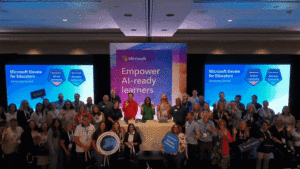
In response, Microsoft is expanding its "Elevate for Educators" program. This initiative offers community support, professional credentials, and capacity-building resources intended to help school leaders and teachers transform their instructional methods. Central to this effort is the AI Literacy Framework, developed in collaboration with the European Commission and the OECD. This framework provides a standardized "playbook" for what students should understand about AI at various stages of their K-12 journey.
To complement these frameworks, Microsoft has partnered with ISTE (International Society for Technology in Education) and ASCD to release an "AI Literacy for Educators" credential pathway. This program aims to move beyond basic technical proficiency, focusing instead on how teachers can integrate AI into their pedagogy to enhance student engagement and accessibility.
From Answer Engines to Learning Coaches: New Technological Frontiers
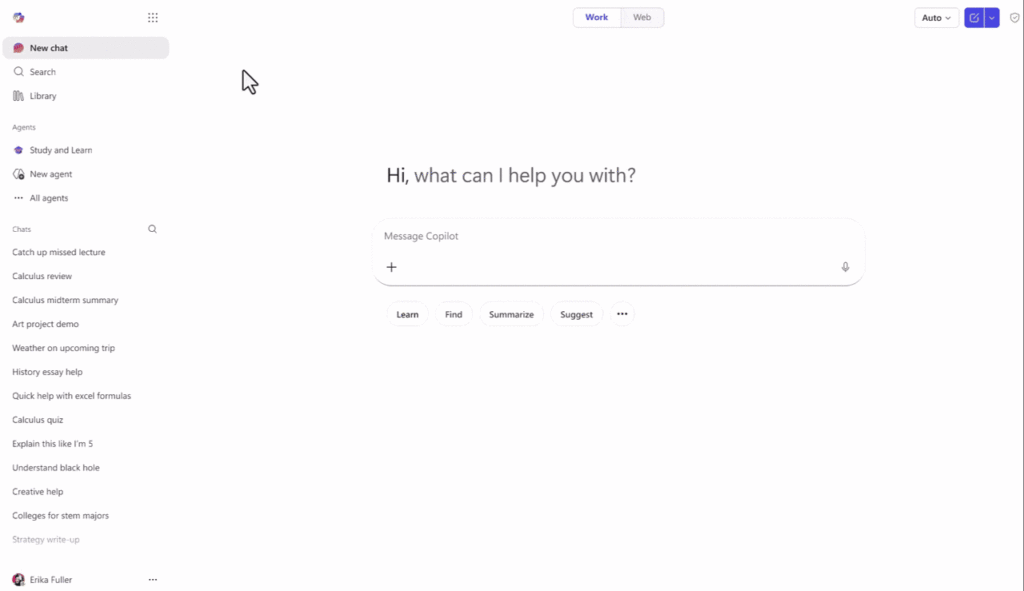
The most significant technological shift announced involves the transformation of Microsoft’s Copilot from a standard "answer engine" into an interactive "Study and Learn Agent." Unlike traditional generative AI that provides a direct answer to a prompt, the Study and Learn Agent is optimized for learning outcomes.

Grounded in research-based principles of scaffolding and active recall, the agent does not complete work for the student. Instead, it asks leading questions, provides immediate feedback, and offers interactive practice tools such as flashcards, quizzes, and matching games. This approach is designed to support knowledge retention and independent thinking, ensuring that students remain the primary drivers of their own intellectual growth.
For students aged 13 and older, this capability is being integrated into Copilot Chat at no additional cost for Microsoft 365 Education users. To maintain institutional control, IT administrators must first enable Copilot Chat for K-12 students, after which the Study and Learn Agent becomes available by default. In the coming months, educators will gain the ability to assign specific uses of this agent within the Microsoft Teams Assignments workflow.
Integrated Workspaces: Copilot Notebooks and Windows Integration
Another key addition is "Copilot Notebooks," an AI-powered workspace within the Microsoft 365 Copilot app. This tool allows students to centralize their lecture slides, handouts, readings, and personal notes. The AI then provides assistance grounded specifically in those uploaded sources, reducing the risk of "hallucinations" (the generation of false information) and keeping the AI’s focus on the curriculum at hand.
The Notebooks feature also includes a "study guide" capability, which can automatically transform a semester’s worth of materials into interactive guides for review and self-testing. This functionality mirrors the "retrieval practice" technique, which cognitive scientists identify as one of the most effective ways to consolidate long-term memory.
To streamline the user experience, Microsoft is introducing "Teach and Learn" taskbar shortcuts on Windows devices. These shortcuts provide personalized access to AI tools directly from the desktop, lowering the barrier to entry for both busy teachers and students.

Data Security and the Role of Institutional Governance
As AI becomes more deeply embedded in school infrastructure, concerns regarding data privacy and security have moved to the forefront of the conversation. Microsoft has emphasized that these new tools are built with "enterprise-grade" protections, ensuring that student data is not used to train the underlying public AI models.
This focus on privacy is a direct response to feedback from the Education Insiders Program, a community of educators and IT professionals who beta-test Microsoft’s features. By providing IT teams with the governance tools needed to manage AI deployments, Microsoft aims to help institutions move toward a more consistent and trusted approach to technology integration.
The report notes that 87% of educators and 79% of students believe that knowing how to use AI effectively and responsibly is crucial for their future careers. However, this future-readiness depends on the ability of schools to provide a safe, regulated environment where AI use is transparent and subject to human oversight.
Analysis of Implications: The Shifting Role of the Educator
The shift toward purpose-built AI tools suggests a profound change in the role of the educator. As AI takes over more of the rote tasks associated with lesson planning and administrative work, teachers are increasingly expected to act as facilitators of high-level discussion and mentors for complex problem-solving.
However, the "training gap" identified in the report remains a critical risk. If 66% of educators feel they lack sufficient training, there is a danger of a "digital divide" occurring not just between students with and without access to technology, but between schools with and without the resources to properly train their staff.

Furthermore, the transition from "answer engines" to "learning coaches" requires a significant shift in student mindset. Students who have grown accustomed to using AI for quick answers may initially resist tools that require them to work through problems. The success of these tools will likely depend on how well they are integrated into the curriculum by teachers who understand the value of cognitive struggle.
Conclusion: Preparing for the 2026-2027 Academic Year
As institutions prepare for the next academic cycle, the focus is clearly on sustainability and pedagogical depth. The announcements from Microsoft reflect a broader industry trend where "generic" AI is being replaced by specialized agents tailored to specific vertical markets—in this case, the highly regulated and scientifically grounded field of education.
The collaboration between tech giants like Microsoft and international bodies like the OECD and European Commission indicates that the future of AI in schools will be governed by a mixture of private innovation and public policy. By aligning technological tools with literacy frameworks and professional credentials, the goal is to create an ecosystem where AI does not replace the teacher or the student, but rather provides the "scaffolding" necessary for both to excel in an increasingly automated world.
The 2026 Microsoft Special Report serves as a reminder that while the technology is ready, the human infrastructure—training, policy, and pedagogy—is still catching up. The coming months will be a critical period for school leaders to decide how they will implement these purpose-built tools to ensure that the next generation of graduates is not just proficient in using AI, but capable of thinking beyond it.