


The modern workplace has entered an era of unprecedented visibility, where the granular details of how employees acquire knowledge are tracked, stored, and analyzed with algorithmic precision. Learning Management Systems (LMS) and Learning Experience Platforms (LXP) have evolved from simple content repositories into sophisticated data engines capable of monitoring completion rates, search queries, hesitation patterns, and the frequency of attempted assessments. As Artificial Intelligence (AI) becomes increasingly integrated into these platforms, the capacity to identify skill gaps and predict future career trajectories has reached new heights. However, this technical evolution has introduced a critical ethical friction point: the threshold at which data collected for professional development is repurposed for organizational judgment.
The Chronology of Digital Surveillance in Learning
The integration of learning data into broader human capital management began in earnest during the shift toward digital-first remote work in 2020. Prior to this period, learning data was largely siloed, residing within standalone training modules that rarely communicated with HR Information Systems (HRIS).
By 2022, the industry saw the rise of "skills-based organizations," a business model that prioritizes the identification and mapping of specific employee competencies. To achieve this, vendors began hard-coding API integrations between learning platforms and talent marketplaces. By 2024, the industry reached a tipping point: many vendors transitioned to default "opt-in" data sharing, meaning that an employee’s practice test results or AI tutor interaction logs could automatically flow into a manager’s dashboard or a talent profile. This shift occurred largely without the explicit, informed consent of the employees being tracked, raising significant questions regarding privacy and the "right to be unfinished."
Supporting Data and the Algorithmic Inference Gap
The core issue lies in the distinction between raw behavioral data and algorithmic inference. According to research from the Association for Talent Development (ATD), approximately 64% of high-performing organizations now utilize AI-driven analytics to map internal talent. While these tools effectively identify potential leaders, they frequently misinterpret behavioral patterns.
For instance, consider the "abandonment rate" of online courses. Traditional analytics might label an employee as "disengaged" if they fail to complete a leadership module. However, external factors—such as shifting project priorities or time constraints—are rarely accounted for in the raw data. Furthermore, repetitive attempts at an assessment, which might suggest a lack of core competency to an AI algorithm, often indicate a high level of persistence and an active desire to master complex subject matter.
A 2023 study by the Workforce Analytics Institute highlighted that when AI systems are allowed to score "competency" based on formative learning data—data generated during the practice phase rather than the mastery phase—the margin of error for employee performance ratings increases by nearly 22%. When these erroneous inferences are tethered to performance reviews, they can result in missed opportunities for promotions, incorrect skill-gap tagging, and the stifling of professional risk-taking.
Official Perspectives and Vendor Responsibilities
The tension between transparency and efficiency has led to a divide among software vendors. Some firms, such as those specializing in privacy-first HR tech, have begun advocating for "data-sovereignty" features. These allow employees to toggle off the synchronization of their learning metadata with external HR platforms.
Conversely, major enterprise software providers argue that the connection of data is essential for "just-in-time" development. A spokesperson for a leading global talent management suite noted that "the ability to connect learning to performance is not about judgment, but about visibility. When we connect these systems, we allow the organization to identify hidden gems—employees who have quietly built skills that are currently needed for new projects."

However, industry analysts suggest that the "visibility" argument often ignores the psychological contract between employer and employee. When employees realize their exploratory searches or candid questions posed to an AI tutor—such as "I don’t understand this" or "I am considering a career shift"—are being logged and potentially shared with management, their behavior shifts. They move from authentic learning to "performing" for the system, avoiding challenging topics that might reveal gaps in their knowledge.
The Five-Stage Governance Framework
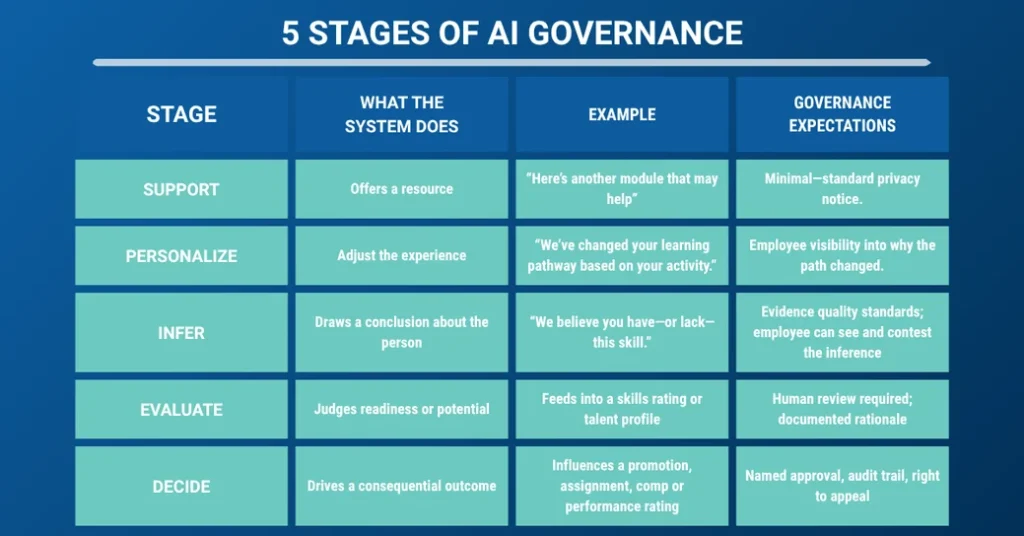
To address these concerns, industry experts are proposing a rigorous governance framework designed to categorize learning data based on its intended consequence. This model, often referred to as the "Support-to-Decide" scale, categorizes AI interactions into five distinct tiers:
- Discovery: Passive content recommendations based on interest.
- Support: AI tutoring or feedback during practice exercises.
- Validate: Testing for basic knowledge retention.
- Evaluate: Assessing competency for specific job-related tasks.
- Decide: Making high-stakes determinations regarding promotions, layoffs, or salary adjustments.
The consensus among ethical AI practitioners is that stages four and five require a "human-in-the-loop" mandate. This means that no promotion or disciplinary decision should be based solely on an AI-generated score. Instead, a qualified manager must review the qualitative evidence alongside the system-generated data, providing a layer of human judgment that understands the context of an employee’s career trajectory.
Broader Implications for Workplace Culture
The long-term risk of failing to govern this data is the erosion of psychological safety. If an employee feels that every click, search, and failed quiz attempt is part of a "permanent record," they will inevitably retreat from experimentation. The very purpose of a corporate learning program is to foster growth, yet the current trajectory of AI integration threatens to turn the learning environment into a high-stakes arena of constant assessment.
From a legal and regulatory perspective, the landscape is also shifting. With the advent of the EU AI Act and similar proposed legislation in the United States, companies may soon be required to disclose how AI systems are used in employment decisions. Learning leaders who fail to audit their vendor contracts now may find themselves non-compliant with future transparency mandates.
Conclusion: The Mandate for Human-Centric Learning
The challenge for modern organizations is to balance the undeniable power of AI-driven personalization with the necessity of maintaining a safe, experimental learning culture. Leaders must move away from the habit of treating "learning data" as a monolithic category. Instead, they must draw a bright line between documentation of success—such as certifications or formal qualifications—and the documentation of the learning process, which should remain private and developmental.
As we look toward the next phase of workforce technology, the ultimate test for any organization will be the "Transparency Test": If a company cannot clearly and comfortably explain to an employee why their search history or AI tutor transcript is being used in a performance review, then the data collection is likely unnecessary and potentially harmful.
The most effective organizations will be those that view their employees as "unfinished" works-in-progress. By prioritizing human oversight and ensuring that employees maintain control over the visibility of their developmental data, companies can harness the benefits of AI without sacrificing the trust and curiosity that are the true foundations of professional growth. The future of work depends not just on the sophistication of our tools, but on our willingness to protect the human space required to learn, struggle, and ultimately, evolve.