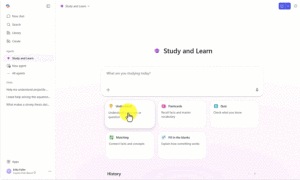



As the global education sector prepares for the 2025-2026 academic calendar, the integration of generative artificial intelligence has transitioned from an experimental novelty to a foundational component of institutional strategy. Microsoft Education has unveiled a comprehensive suite of AI-driven tools, centered on Microsoft 365 Copilot and the newly announced Microsoft Learning Zone, designed to address the multifaceted challenges of modern schooling. These initiatives aim to mitigate the rising administrative burden on educators while fostering a more personalized, inclusive learning environment for students. The shift represents a significant move toward "human-centric AI," where technology is leveraged not to replace the educator, but to reclaim the time necessary for high-impact instructional engagement.
The Strategic Evolution of AI in Academic Environments
The current push for AI integration follows a period of rapid digital transformation that began during the global pandemic and accelerated with the emergence of large language models (LLMs) in late 2022. According to industry data, educators are currently facing unprecedented levels of burnout, with administrative tasks such as lesson planning, grading, and stakeholder communication occupying nearly 50% of their weekly hours. Microsoft’s latest rollout is positioned as a direct response to this "time poverty," offering automated solutions that streamline workflows and allow for data-driven decision-making.
The chronology of this development highlights a steady progression. In early 2023, Microsoft began integrating GPT-4 capabilities into its productivity suite. By mid-2024, the company expanded access to Copilot for students aged 13 and older, recognizing the need for AI literacy as a prerequisite for future workforce readiness. The August 2025 updates represent the third major phase of this evolution, focusing on specialized "Learning Accelerators" and the public preview of the Microsoft Learning Zone, an AI-powered hub specifically tailored for pedagogical use.
Optimizing Educator Workflows via Copilot Chat
At the heart of the new academic toolkit is Copilot Chat, a secure, enterprise-grade AI interface designed to function as a virtual teaching assistant. For administrators and faculty, the primary utility lies in its ability to synthesize information and generate drafts across various formats. The tool is being utilized to draft curriculum-aligned lesson plans, create differentiated rubrics for diverse learners, and manage the high volume of parent-teacher correspondence that characterizes the start of the school year.
Statistical analysis of pilot programs indicates that educators using AI assistance can reduce lesson preparation time by as much as 30%. This efficiency is not merely about speed; it allows for a higher degree of instructional personalization. For example, an educator can prompt Copilot to adapt a complex scientific concept into multiple reading levels within seconds, a task that would manually require hours of research and editing. Furthermore, the integration of AI into Microsoft Teams for Education ensures that these efficiencies are embedded within the communication platforms already familiar to school districts, reducing the "app fatigue" often associated with new technology adoptions.

Empowering the Next Generation: Student-Facing AI and Digital Literacy
The expansion of Copilot Chat to students aged 13 and older marks a pivotal shift in the educational landscape. Microsoft has implemented strict safety guardrails and data privacy protections to ensure that student interactions remain within a protected environment. The objective is to move students from passive consumers of technology to active, responsible users of AI.
Educational experts suggest that the "thought partner" model of AI can significantly boost student confidence. By engaging with Copilot, students can brainstorm essay outlines, clarify complex mathematical theorems, or practice language acquisition in a low-stakes environment. However, this rollout is accompanied by a strong emphasis on digital literacy. Microsoft’s curriculum resources now include modules on AI ethics, prompt engineering, and the critical evaluation of AI-generated content. This ensures that as students utilize these tools for academic support, they are also developing the skepticism and analytical skills necessary to navigate an increasingly automated information ecosystem.
Data-Driven Personalization through Learning Accelerators
Beyond general productivity, Microsoft has refined its "Learning Accelerators"—a suite of AI-powered tools integrated into Microsoft 365 that target foundational skills. These include Reading Progress, Reading Coach, Math Progress, and Speaker Coach. These tools provide real-time, individualized feedback to students while simultaneously collecting granular data for educators.
For instance, Reading Coach uses AI to identify specific words a student finds challenging and provides immediate practice exercises. Simultaneously, the Reading Progress tool generates data visualizations for the teacher, highlighting class-wide trends or specific student plateaus. This "loop" of feedback and data allows for "just-in-time" intervention, where educators can address learning gaps before they become systemic. Recent literacy studies have shown that students using AI-assisted reading tools show a marked improvement in fluency compared to those using traditional methods alone, primarily due to the increased frequency of personalized practice.
Institutional Responses and Global Implementation Case Studies
The adoption of Microsoft’s AI tools has seen significant traction across diverse educational settings, from K-12 districts to higher education institutions. Early adopters report that the primary benefit is the ability to scale "concierge-level" support to a larger student body.
In various school districts, administrators have noted that AI-powered analytics are helping to identify students at risk of falling behind much earlier in the term. By analyzing engagement metrics and assessment data through AI, schools can allocate resources more effectively. Institutional leaders have expressed that the security of the Microsoft ecosystem—specifically the fact that data is not used to train underlying public models—is the deciding factor for adoption. This addresses the primary concern of school boards regarding the privacy of student records and intellectual property.

The Microsoft Learning Zone and the Role of Specialized Hardware
A major component of the 2025 back-to-school strategy is the public preview of the Microsoft Learning Zone. This app is designed to be an adaptive learning environment where educators can create customized pathways for students. Unlike generic AI tools, the Learning Zone is built on learning science principles, ensuring that the AI’s suggestions align with pedagogical best practices.
The effectiveness of these software tools is being paired with the rollout of Copilot+ PCs and updated Microsoft Surface devices. These hardware units feature dedicated Neural Processing Units (NPUs) designed to handle AI tasks locally, ensuring faster performance and enhanced privacy. This synergy between software and hardware indicates a long-term commitment to making AI a seamless, "always-on" part of the educational infrastructure.
Analysis of Broader Implications for the Global Education Sector
The comprehensive push by Microsoft to embed AI into every facet of the school year has profound implications for the future of education. First, it signals the end of the debate over whether AI belongs in the classroom; the focus has now shifted entirely to how it should be implemented. This requires a significant investment in professional development, as the "AI gap"—the difference between those who can effectively use these tools and those who cannot—threatens to become a new form of the digital divide.
Second, the move toward data-driven instruction via Learning Accelerators suggests a shift toward competency-based education. As AI tools make it easier to track individual progress in real-time, the traditional "one-size-fits-all" model of the classroom may give way to more fluid, individualized schedules where students move at their own pace.
Finally, there is the economic implication. By streamlining administrative tasks, institutions may be able to operate more efficiently in the face of tightening budgets. However, the reliance on a single ecosystem for both productivity and pedagogical tools raises questions about long-term platform dependency.
Conclusion: A New Chapter in Pedagogical Innovation
As the 2025-2026 school year begins, the role of the educator remains as critical as ever, yet the nature of the work is changing. Microsoft’s suite of AI tools offers a glimpse into a future where technology handles the routine and the analytical, freeing the human educator to focus on the relational and the inspirational. The successful integration of these tools will depend not just on the technology itself, but on the willingness of institutions to embrace a culture of continuous learning and ethical adaptation. By providing the resources, security, and data necessary for this transition, Microsoft is positioning itself as a central architect in the next era of global education, where the goal is to empower every student and educator to achieve more through the collaborative power of human and artificial intelligence.